Home › Swarms
For the publicI'r cyhoedd
Do you have a honeybee swarm?
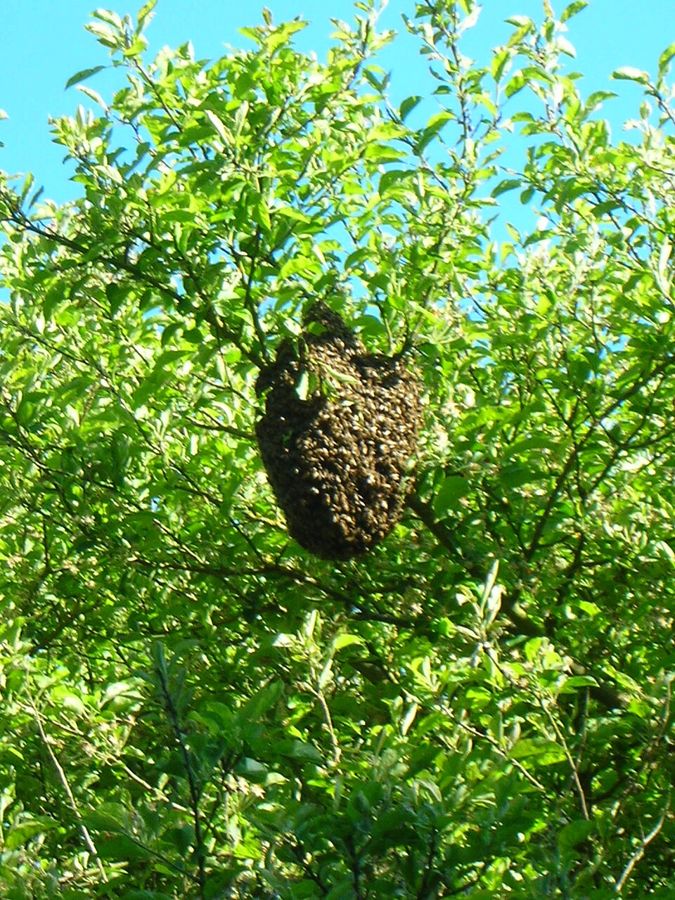
Our volunteer swarm collectors cover Swansea, Gower, Neath, Port Talbot and the valleys around them. Swarming is how a colony reproduces. A swarm can look frightening, but honeybees are usually not aggressive at this stage. A cluster hanging from a branch will usually move on within a day or two. Our beekeepers are volunteers who will gladly collect honeybee swarms from accessible places.
- Stay calm and keep your distance. Don't touch or disturb the swarm, and keep children and pets away.
- Check that they're honeybees using the picker below. We can only help with honeybees. For wasps or other insects, please contact a pest control service.
- Take a photo if you can do so safely. It helps us identify the insects and plan the collection.
- Report the swarm using our form, with the exact location. A What3Words or Plus Code from Google Maps is a big help.
Bees in a building?
We can't remove established colonies from walls, chimneys, roofs or other hard-to-reach places. The British Beekeepers Association has helpful guidance on bees in buildings.
Bumblebees and solitary bees
These don't swarm and are best left alone. They're harmless, valuable pollinators and will be gone by the end of the summer.
Is it a honeybee?
Tap the insect that looks most like yours and we'll tell you what to do.
Photos from Wikimedia Commons: Honeybee by John Severns (Severnjc) (public domain); Bumblebee by Charles J. Sharp (CC BY-SA 4.0); Wasp by Soebe (CC BY-SA 3.0); Asian hornet by Charles J. Sharp (CC BY-SA 4.0). Not sure? Send us a photo with your swarm report and we'll identify it.
Report itRhowch wybod
Report a swarm
Urgent, or the form won't work? Email swarms@wgbka.org. When you send a report, our swarm collectors near you get an alert straight away.
We only use your details to deal with your report. See our privacy notice.
Report a swarm
We can only deal with honeybees in accessible locations. A volunteer will be in touch as soon as possible.