Our history · Ein hanes

Nearly 150 years of beekeepers in Glamorgan

Our association dates back to 1878, when beekeepers were swapping straw skeps for the new wooden bar-frame hives that we still use today. We're piecing the story together from old newspapers, minute books and members' memories, and this page will grow as we find more.

Dancing among the bees

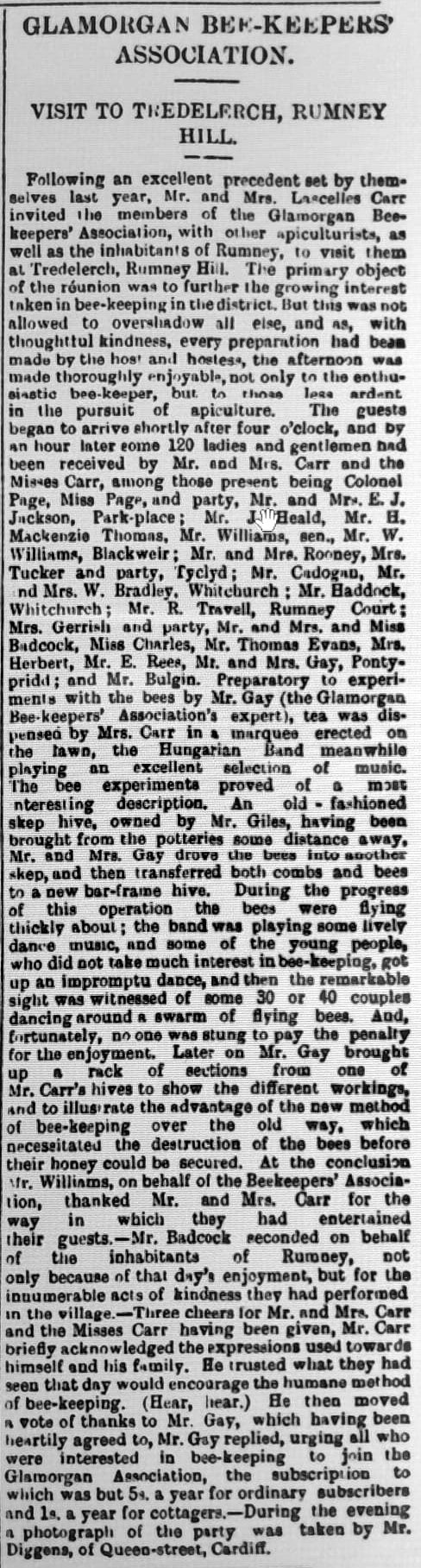
One of our favourite finds is a framed newspaper report from the summer of 1890. It describes an afternoon at Tredelerch, the house on Rumney Hill near Cardiff that belonged to Lascelles Carr, editor of the Western Mail, when the Glamorgan Bee-keepers' Association came to visit.

Newspaper report headed Glamorgan Bee-keepers' Association, Visit to Tredelerch, Rumney Hill
The original report, about 1890. Tap to enlarge, or read the full transcription below.

Mr and Mrs Carr had invited the association, "other apiculturists" and the people of Rumney for an afternoon of bees. By five o'clock some 120 guests had arrived. Tea was served in a marquee on the lawn while the Hungarian Band played.

Then came the main event. Mr Gay, the association's expert, and Mrs Gay took an old straw skep, brought from the potteries some distance away, and "drove" the bees out of it into an empty skep. They then moved the combs and bees into a modern bar-frame hive.

"The remarkable sight was witnessed of some 30 or 40 couples dancing around a swarm of flying bees."

With the air full of bees, the band struck up some lively dance music. Some of the younger guests, who "did not take much interest in bee-keeping", started an impromptu dance among them. The reporter notes that, fortunately, nobody was stung.

Mr Gay then lifted a rack of honey sections from one of Mr Carr's own hives. He used it to show why the new frame hives were better than the old skeps, which usually meant killing the bees to get at the honey. Mr Carr hoped the day would "encourage the humane method of bee-keeping", and Mr Gay urged everyone to join the association.

5sa year to join, for ordinary members
1sa year for cottagers, so working families could join
0stings reported, despite 30 or 40 couples dancing

When did it happen?

The clipping has no date on it, but the page gives us some clues. The shipping adverts next to it list sailings for late July and early August. They also mention the "Inman and International Steamship Company", a name used only from 1886 to 1893. The report says the Carrs were following "an excellent precedent set by themselves last year", and the association's annual report for 1889 records that the first demonstration at Tredelerch was on 19 June 1889. That makes it very likely that this second visit took place in the summer of 1890, and was probably reported in the Western Mail.

Read the full transcription

GLAMORGAN BEE-KEEPERS' ASSOCIATION.

VISIT TO TREDELERCH, RUMNEY HILL.

Following an excellent precedent set by themselves last year, Mr. and Mrs. Lascelles Carr invited the members of the Glamorgan Bee-keepers' Association, with other apiculturists, as well as the inhabitants of Rumney, to visit them at Tredelerch, Rumney Hill. The primary object of the réunion was to further the growing interest taken in bee-keeping in the district. But this was not allowed to overshadow all else, and as, with thoughtful kindness, every preparation had been made by the host and hostess, the afternoon was made thoroughly enjoyable, not only to the enthusiastic bee-keeper, but to those less ardent in the pursuit of apiculture. The guests began to arrive shortly after four o'clock, and by an hour later some 120 ladies and gentlemen had been received by Mr. and Mrs. Carr and the Misses Carr, among those present being Colonel Page, Miss Page, and party, Mr. and Mrs. E. J. Jackson, Park-place; Mr. J. Heald, Mr. H. Mackenzie Thomas, Mr. Williams, sen., Mr. W. Williams, Blackweir; Mr. and Mrs. Rooney, Mrs. Tucker and party, Tyclyd; Mr. Cadogan, Mr. and Mrs. W. Bradley, Whitchurch; Mr. Haddock, Whitchurch; Mr. R. Travell, Rumney Court; Mrs. Gerrish and party, Mr. and Mrs. and Miss Badcock, Miss Charles, Mr. Thomas Evans, Mrs. Herbert, Mr. E. Rees, Mr. and Mrs. Gay, Pontypridd; and Mr. Bulgin. Preparatory to experiments with the bees by Mr. Gay (the Glamorgan Bee-keepers' Association's expert), tea was dispensed by Mrs. Carr in a marquee erected on the lawn, the Hungarian Band meanwhile playing an excellent selection of music. The bee experiments proved of a most interesting description. An old-fashioned skep hive, owned by Mr. Giles, having been brought from the potteries some distance away, Mr. and Mrs. Gay drove the bees into another skep, and then transferred both combs and bees to a new bar-frame hive. During the progress of this operation the bees were flying thickly about; the band was playing some lively dance music, and some of the young people, who did not take much interest in bee-keeping, got up an impromptu dance, and then the remarkable sight was witnessed of some 30 or 40 couples dancing around a swarm of flying bees. And, fortunately, no one was stung to pay the penalty for the enjoyment. Later on Mr. Gay brought up a rack of sections from one of Mr. Carr's hives to show the different workings, and to illustrate the advantage of the new method of bee-keeping over the old way, which necessitated the destruction of the bees before their honey could be secured. At the conclusion Mr. Williams, on behalf of the Beekeepers' Association, thanked Mr. and Mrs. Carr for the way in which they had entertained their guests.—Mr. Badcock seconded on behalf of the inhabitants of Rumney, not only because of that day's enjoyment, but for the innumerable acts of kindness they had performed in the village.—Three cheers for Mr. and Mrs. Carr and the Misses Carr having been given, Mr. Carr briefly acknowledged the expressions used towards himself and his family. He trusted what they had seen that day would encourage the humane method of bee-keeping. (Hear, hear.) He then moved a vote of thanks to Mr. Gay, which having been heartily agreed to, Mr. Gay replied, urging all who were interested in bee-keeping to join the Glamorgan Association, the subscription to which was but 5s. a year for ordinary subscribers and 1s. a year for cottagers.—During the evening a photograph of the party was taken by Mr. Diggens, of Queen-street, Cardiff.

Transcribed from the framed clipping, keeping the original spelling. One initial ("Mr. J. Heald") is hard to read on the original.

Timeline

What we know so far. Most of the Victorian entries come from newspaper reports of the county-wide Glamorganshire association, which had district secretaries in Swansea, Mumbles and Neath.

  1. 1878

    Our association is founded

    The date our club has always given for its founding. If you know where the earliest records are kept, please tell us.

  2. 1880s

    The Glamorganshire Bee-keepers' Association

    A county association is set up as the Glamorgan branch of the British Bee-keepers' Association. Its fourth annual report was read in February 1890, so it was probably formed around 1886.

  3. 1887

    A county expert, and local secretaries

    At the annual meeting in Cardiff, Mr W. Gay, a certified expert of the British Bee-keepers' Association, is elected the county's expert. The committee includes members from Sketty and Neath, with district secretaries for Swansea (the Rev. E. Davies of Clydach Vicarage) and Mumbles. Mr Gay tells the meeting that every member has now adopted the bar-frame hive.

  4. 1889

    The first Tredelerch demonstration

    On 19 June, Mr Gay gives a lecture and a display of bee handling at Lascelles Carr's home near Cardiff. That year the association has 48 members, holds its show with the county agricultural show at Treorchy, and Mr Gay's rounds take in 84 hives and ten skeps, with no foul brood found.

  5. 1890

    Dancing among the bees

    The second visit to Tredelerch, when 30 or 40 couples danced around a swarm of flying bees. Read the story above.

  6. 1895

    700 beekeepers in the county

    The secretary reports that Glamorgan has about 700 beekeepers, but only around 150 belong to the association. He suggests local committees across the county and a market for Welsh honey.

  7. 1916

    Wartime and the "Isle of Wight disease"

    The annual meeting is held in Swansea, chaired by Alderman John Jordan of Llansamlet. Members discuss the Isle of Wight disease, which was wiping out colonies across Britain, and the loss of the county council's grant because of the war.

  8. 2028

    150 years

    Our 150th anniversary. Help us fill in the years between, from the Second World War and the creation of West Glamorgan in 1974 to the present day.

Help us tell the rest of the story

Do you have anything from the club's past tucked away in a drawer or a loft? We'd love to hear about:

We can scan things and give them straight back.

Email info@wgbka.org

Sources